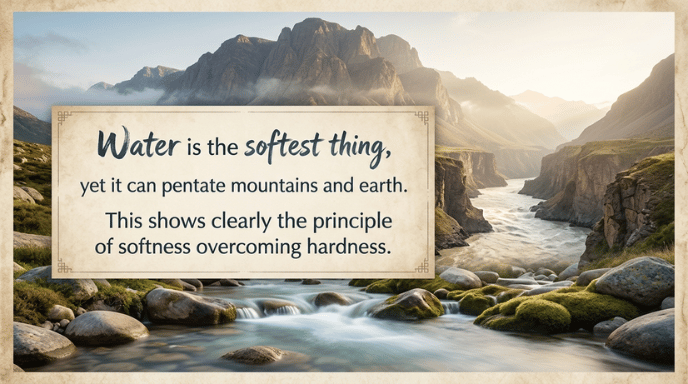
Water is the softest thing, yet it can penetrate mountains and earth. This shows clearly the principle of softness overcoming hardness.
By: Lao Tzu (Tao Te Ching) | Published on May 16,2026
Category Spiritual Quotes
About This Quote
This profound teaching comes from Lao Tzu, the ancient Chinese philosopher and founder of Taoism, whose writings in the Tao Te Ching have guided spiritual seekers for over 2,500 years. Lao Tzu was deeply observant of nature, drawing spiritual lessons from natural phenomena. Water was one of his primary teachers—he wrote about it repeatedly throughout the Tao Te Ching, recognizing in water's behavior the fundamental principles of the Tao (the Way).
This particular teaching appears in Chapter 78 of the Tao Te Ching, where Lao Tzu is teaching about the power of yielding, the strength of flexibility, and how apparent weakness can be the greatest strength. He looked at water—the softest, most yielding substance—and saw in it one of nature's most powerful forces. Water doesn't fight the mountain; it flows around, through, and over it. Yet given enough time, water carves canyons through solid rock.
Why It Resonates
Think about how you approach obstacles in your life. Your instinct is probably to meet force with force. Someone pushes you, you push back harder. You encounter resistance, you apply more effort. You face a hard problem, you attack it with hard determination. You believe that overcoming obstacles requires hardness, strength, force.
But this approach exhausts you. You're constantly battling. Constantly straining. Constantly trying to be harder than the hardness you encounter. And often, you lose. The obstacle is harder than you. The resistance is stronger than your force. You break yourself against the immovable object.
Then you encounter this teaching from Lao Tzu: Water is the softest thing. Yet it can penetrate mountains and earth.
Wait. What?
Water isn't hard. Water doesn't fight. Water is soft, yielding, flexible. It takes the shape of whatever contains it. It flows around obstacles rather than through them. It seems weak, passive, powerless.
Yet water carved the Grand Canyon. Water shapes coastlines. Water splits rocks. Water, over time, is one of the most powerful forces in nature. Not despite its softness, but because of it.
This resonates because you're exhausted from trying to be hard. From forcing your way through resistance. From meeting hardness with hardness. And you're starting to suspect there might be another way—a way that doesn't require you to become rigid, aggressive, and forceful to be effective.
The Spiritual Wisdom Behind It
This teaching is central to Taoist philosophy. The Tao Te Ching repeatedly uses water as the ideal metaphor for how to live in harmony with the Tao. Chapter 8 says: "The highest good is like water. Water gives life to the ten thousand things and does not strive. It flows in places men reject and so is like the Tao."
Water doesn't try to prove its power. It doesn't announce its strength. It simply flows, yielding to every obstacle, adapting to every container, taking the path of least resistance. And through this apparent weakness, it accomplishes what force cannot.
This connects to the Taoist concept of Wu Wei—effortless action, or action without forcing. Wu Wei doesn't mean doing nothing; it means acting in harmony with natural patterns rather than against them. Water embodies Wu Wei perfectly. It doesn't force its way through obstacles—it finds the path that opens naturally.
In Zen Buddhism, there's a teaching: "Be like water making its way through cracks." Don't insist on your way being the only way. Don't try to force reality to conform to your plans. Be flexible enough to find the openings, the cracks, the natural paths.
Christianity speaks of "the meek shall inherit the earth." This isn't about weakness—it's about the power of gentleness, flexibility, and humility. The same principle: what appears soft and yielding ultimately prevails over what appears hard and unyielding.
Modern psychology has discovered what Lao Tzu knew 2,500 years ago: psychological flexibility—the ability to adapt, to yield, to approach problems from different angles—is associated with better mental health, greater resilience, and more effective problem-solving than rigid, forceful approaches.
The Deeper Meaning
This quote is teaching you about the relationship between apparent weakness and true power. Most people confuse hardness with strength. They believe that being powerful means being rigid, unyielding, forceful. But Lao Tzu is revealing a paradox: the softest thing is the most powerful thing.
"Water is the softest thing"—this acknowledges the apparent weakness. Water has no shape of its own. It yields to every container. It flows around every obstacle. It seems powerless, passive, weak. By conventional standards, water shouldn't be powerful at all.
"Yet it can penetrate mountains and earth"—this reveals the hidden strength. Water doesn't penetrate through force. It penetrates through persistence, flexibility, and time. It finds the cracks. It flows into the spaces. It freezes and expands. It wears away resistance gradually. And eventually, the mountain yields to the water.
"This shows clearly the principle of softness overcoming hardness"—this is the core teaching. Your hardness—your rigidity, your force, your refusal to yield—is actually your weakness. The more rigid you are, the easier you break. The more forceful you are, the more resistance you create. The harder you push, the harder life pushes back.
But if you become like water—soft, flexible, yielding—you become unstoppable. Not through force, but through persistence. Not through rigidity, but through adaptability. Not through fighting obstacles, but through flowing around them.
The deeper wisdom is that this isn't just about dealing with external obstacles. It's about your entire approach to life. Are you trying to force life to conform to your will? Or are you flowing with life's patterns? Are you rigid in your expectations? Or flexible in your responses? Are you meeting force with force? Or meeting force with yielding?
Water teaches: yield to overcome. Be soft to be strong. Flow to penetrate. Adapt to prevail.
Living This Truth
Practice yielding instead of forcing. When you encounter resistance, instead of pushing harder, look for where the opening is. Like water, find the crack, the space, the path that opens naturally. Don't force the door that's locked—find the one that's open.
Develop flexibility in your approaches. Water takes the shape of whatever contains it. You can be like this—adapting your strategy to the situation, rather than insisting on one rigid approach. Multiple paths lead to the same destination. Be flexible enough to take whichever one is open.
Persist without forcing. Water doesn't give up, but it also doesn't attack. It persistently seeks the path of least resistance. Keep moving toward your goals, but be willing to take indirect routes. Sometimes the long way around is the only way through.
Let go of the need to appear strong. Hardness looks strong but is actually brittle. Softness looks weak but is actually flexible. Stop performing strength through rigidity. True strength is in your ability to bend without breaking, to yield without surrendering.
Practice strategic retreat. Water flows downhill—it takes the low place, the humble position. Sometimes the powerful move is to step back, to yield ground, to take the low position. This isn't weakness—it's strategic flexibility.
And trust in gradual change. Water doesn't split the rock in one day. But over time, persistent water transforms entire landscapes. You don't need to force immediate change. Just keep flowing, persistently, in the right direction. Time and consistency will penetrate what force cannot.
Your Reflection Today
Where in your life are you trying to overcome hardness with hardness—meeting force with force, fighting resistance with more effort?
What would it look like to be like water in that situation—to find the crack, to flow around the obstacle, to persist without forcing?
Can you trust that softness, flexibility, and persistent flow might be more powerful than rigidity, force, and direct confrontation?
Here's what Lao Tzu wants you to understand: You're trying to be powerful by being hard. Rigid in your approach. Forceful in your efforts. Unyielding in your expectations. And it's not working. The harder you become, the more you break. The more you force, the more resistance you encounter. The more rigid you are, the more fragile you become.
You're trying to split the mountain by being harder than the mountain. But the mountain is made of rock. You're made of flesh. You cannot win this battle through hardness.
But water wins. Water, which has no hardness at all. Water, which yields to every obstacle. Water, which takes the shape of whatever contains it. Water, which appears weak and powerless.
Water wins not through force, but through softness. Not through rigidity, but through flexibility. Not through confrontation, but through flow.
Think about it: the hardest substances in nature—diamond, granite, steel—can all be shaped, worn down, or broken by water. Given enough time. Given enough persistence. Not through water becoming harder, but through water remaining soft.
You're facing obstacles in your life—hard problems, rigid people, immovable circumstances. And you're trying to overcome them through force. But force creates resistance. Hardness meets hardness and both break.
What if you became like water instead?
Not passive. Not weak. Not giving up. But soft. Flexible. Persistent.
When you encounter the obstacle, don't try to break through it. Flow around it. Find the crack. Seek the opening. Take the path that yields naturally.
When someone pushes you, don't push back harder. Yield. Let their force pass through the space where you were. Then continue flowing in your direction.
When circumstances resist your plans, don't force your way through. Adapt. Find another path. Be flexible enough to achieve your goal through a different route.
This is the principle of softness overcoming hardness. This is the power of water. This is the way of the Tao.
You don't need to become harder to become stronger. You need to become softer. More yielding. More flexible. More like water.
Because water—soft, gentle, yielding water—can penetrate mountains and earth. Can shape coastlines. Can carve canyons. Can wear away anything, given enough time and persistence.
Not through force. Through flow. Not through hardness. Through softness. Not through confrontation. Through adaptation.
Be like water. Soft, yet powerful. Yielding, yet persistent. Flexible, yet unstoppable.
That's true strength. That's the way that overcomes all obstacles. Not through being harder than them, but through being softer, more patient, more persistent than they are.
The softest thing overcomes the hardest thing. Always has. Always will.
Be soft. Be like water. 💧🏔️✨
Amazon Affiliate Disclosure
As an Amazon Associate I earn from qualifying purchases.
Comments
No comment yet. Be the first to comment