
Why don't scientists trust atoms? Because they make up everything
By: Compiled from various sources | Published on Jan 14,2026
Category Jokes
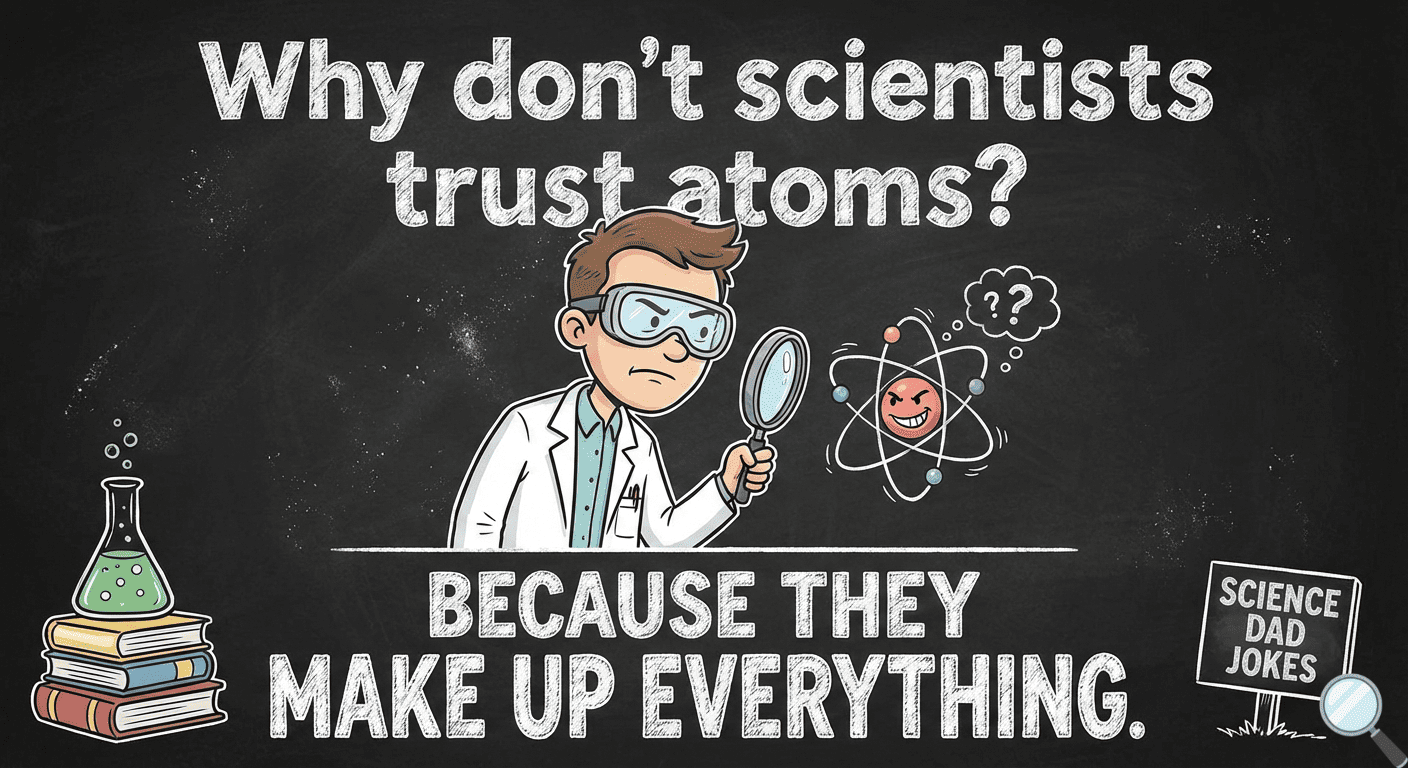
About This Joke
This clever wordplay has circulated through classrooms, science labs, and social gatherings for years, delighting chemistry students and pun enthusiasts alike. While its exact origin is unknown—as is common with many excellent puns—it represents the perfect marriage of scientific knowledge and linguistic cleverness. The joke works on two levels: the scientific fact that atoms literally compose all matter, and the colloquial phrase "make up" meaning to fabricate or lie. It's a testament to how humor can make complex scientific concepts memorable and approachable.
Why It Resonates
Think about how we use humor to process complex or intimidating topics. Science—particularly at the atomic level—can feel abstract, difficult, incomprehensible to many people. Atoms are invisible, theoretical to our daily experience, yet fundamental to everything that exists.
This joke humanizes atoms. It gives them personality—making them untrustworthy characters who "make things up." It transforms an abstract scientific concept into something relatable: we all know people who "make things up," who can't be trusted because they fabricate stories.
The humor comes from the unexpected connection. Your brain hears "scientists don't trust atoms" and thinks there might be some complex scientific reason. Then the punchline lands: "they make up everything"—and suddenly you're laughing at the double meaning. The atoms aren't untrustworthy in a moral sense; they're literally the building blocks of all matter. They "make up" everything by composing it.
It's the kind of joke that makes you groan and smile simultaneously. The groan comes from the obviousness once you get it. The smile comes from appreciating the cleverness. And if you're a science person, there's extra delight in the accuracy—atoms really do make up everything.
The Psychology Behind It
Research on humor reveals that wordplay and puns activate specific cognitive processes. Your brain has to hold two meanings of a word simultaneously, recognize the intended ambiguity, and resolve the unexpected connection. This cognitive surprise—the moment of "getting it"—triggers laughter.
Studies show that puns and wordplay are actually quite sophisticated forms of humor. They require linguistic intelligence, the ability to think flexibly about language, and quick mental shifting between different meanings. People who appreciate puns tend to score higher on tests of verbal intelligence and creative thinking.
There's also the "benign violation theory" of humor, developed by researchers Peter McGraw and Caleb Warren. Humor often involves something that's wrong, threatening, or violates expectations (the violation), but in a safe, playful context (the benign part). This joke violates your expectation of what "make up" means—you expect moral untrustworthiness but get literal composition instead—but it does so in a completely harmless, playful way.
Neuroscience shows that when you "get" a joke, your brain experiences a small reward response—a hit of dopamine. That's why jokes feel good. This particular joke delivers that reward through the "aha" moment when the double meaning clicks into place. Your brain loves solving puzzles, and good wordplay is essentially a mini puzzle.
The Deeper Meaning
On the surface, this is just a silly science pun. But there's something subtly profound here about perspective and truth.
From one perspective, atoms are untrustworthy—they literally make up everything, meaning nothing is "real" in the solid, permanent way we experience it. The chair you're sitting on? Mostly empty space with atoms that are themselves mostly empty space. Your body? Constantly exchanging atoms with the environment. Everything you think is solid and real is actually a temporary arrangement of particles that are themselves mysterious quantum phenomena.
From another perspective, atoms are the most trustworthy thing in existence—they follow consistent laws, behave predictably, and literally make up all of reality. Everything you can see, touch, taste, smell, or experience is made of atoms. They're the foundation of existence itself.
The joke accidentally touches on this philosophical tension: what does it mean that everything is "made up"? Are atoms creating reality or fabricating it? Both? Neither?
Of course, the joke isn't trying to be philosophical—it's just having fun with language. But the best humor often contains little nuggets of truth, even when it's not trying to.
Living This Truth
Use humor to make difficult concepts approachable. Whether you're a teacher, parent, or just someone trying to understand complex topics, remember that a good joke or pun can make information memorable and less intimidating. Atoms become friendlier when they're characters in a joke.
Appreciate wordplay for the mental exercise it provides. Puns might make people groan, but they're actually exercising your brain's linguistic flexibility. They're training you to see multiple meanings, to think creatively about language, to make unexpected connections.
Don't take yourself too seriously. If scientists—who study the fundamental nature of reality—can make puns about atoms, you can probably lighten up about whatever serious thing you're dealing with. Humor doesn't diminish importance; it makes important things more bearable.
Share jokes that make you think. The best humor isn't just funny—it makes you see something from a new angle. This joke makes you think about atoms differently, even if just for a moment. That's the power of good wordplay.
Your Reflection Today
When was the last time you let yourself laugh at a silly pun or joke?
What complex or intimidating topic in your life could benefit from a lighter, more playful approach?
Can you appreciate the cleverness in simple things, or do you dismiss them as "just jokes"?
Here's what this joke wants you to understand: Not everything has to be serious all the time. Science is serious—atoms are literally the building blocks of reality. But we can still play with the language we use to talk about them. We can still find humor in the double meanings and unexpected connections.
Atoms make up everything. That's a profound scientific truth. Atoms make up everything. That's also a ridiculous reason not to trust them. Both can be true simultaneously. That's the magic of language, the joy of wordplay, the delight of a good pun.
So the next time someone tells you a joke that makes you groan, remember: your brain just got a little workout. You processed multiple meanings simultaneously, recognized an unexpected pattern, and experienced the small joy of "getting it."
That groan-inducing pun? It's actually a sign of cognitive sophistication wrapped in silliness.
And in a world that often takes itself too seriously, maybe we need more jokes about atoms being untrustworthy fabricators of reality.
After all, they do make up everything. 😄🔬
Amazon Affiliate Disclosure
As an Amazon Associate I earn from qualifying purchases.
Comments
No comment yet. Be the first to comment