
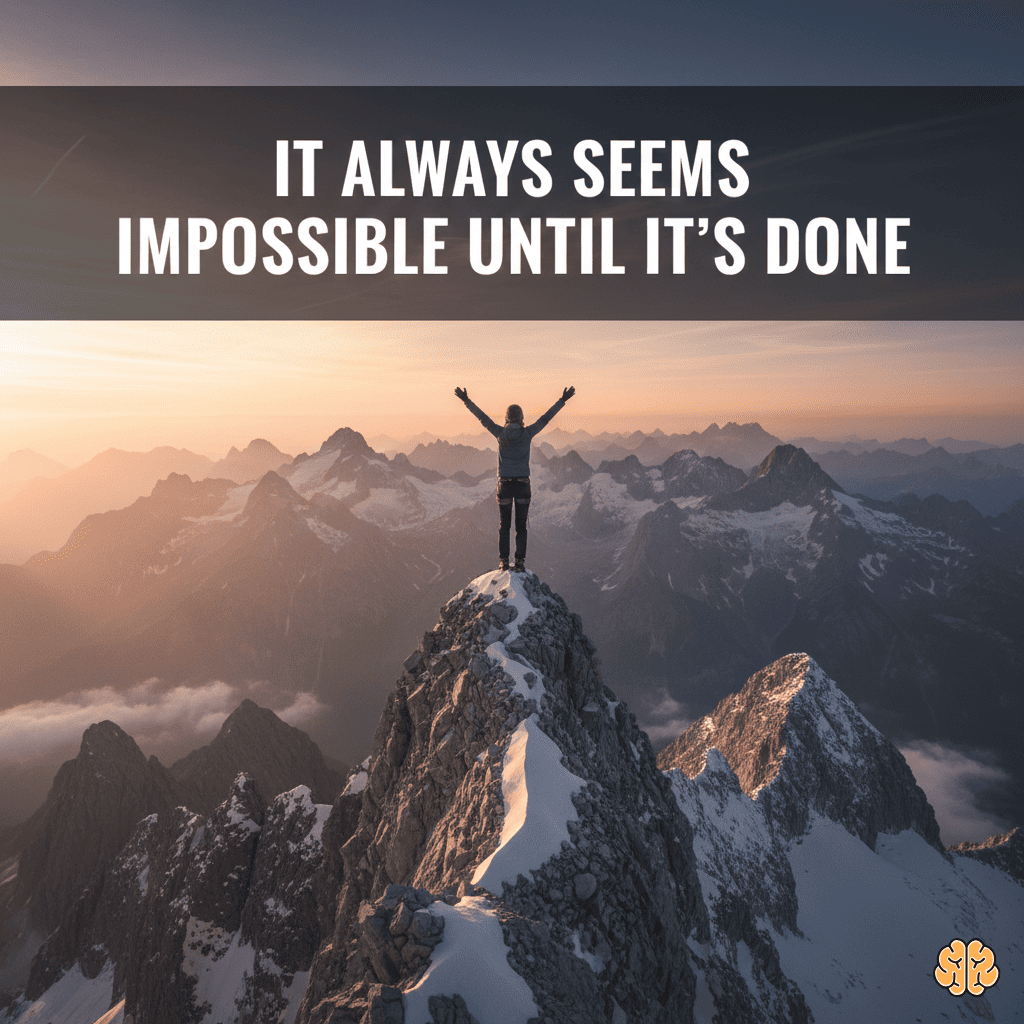
It always seems impossible until it's done.
By: Nelson Mandela (1918-2013) | Published on Jan 04,2026
Category Quote of the Day
About This Quote
This powerful statement comes from Nelson Mandela, the South African anti-apartheid revolutionary, political leader, and philanthropist who spent 27 years in prison for his fight against racial segregation before becoming South Africa's first Black president. Mandela knew something about impossible dreams—he lived them. When he spoke these words, he wasn't offering theoretical motivation or empty platitudes. He was speaking from lived experience of achieving what the entire world thought was impossible: the peaceful end of apartheid and the establishment of democratic rule in South Africa.
This quote appears in various speeches and writings from Mandela's later years, particularly when reflecting on his long struggle for freedom and justice. It's become one of his most frequently cited statements because it captures his entire life philosophy: that persistence, courage, and refusal to give up can transform the impossible into the inevitable.
Why It Resonates
Think about what you're facing right now that seems impossible. Maybe it's getting out of debt when the numbers feel insurmountable. Maybe it's healing from trauma that feels too deep. Maybe it's building a business when you have no money or connections. Maybe it's losing weight when you've failed so many times before. Maybe it's leaving a toxic relationship when you're terrified of being alone. Maybe it's changing a career when you feel too old or unqualified.
Whatever it is, you've probably looked at it and thought: "This is impossible. I can't do this. The gap between where I am and where I need to be is too wide. The obstacles are too many. The odds are too low. I should just give up."
And here's the thing: it does seem impossible. Right now, from where you're standing, it genuinely looks like you cannot get there from here. The math doesn't add up. The path isn't clear. The resources aren't available. The circumstances aren't favorable.
Mandela understands this. He's not dismissing your sense of impossibility or telling you you're wrong to feel overwhelmed. He spent 27 years in prison—nearly three decades of his life locked in a cell, separated from his family, watching the world change without him. Every logical assessment said: "You will never be free. Apartheid will never end. You will die in this prison."
It seemed impossible. Until it wasn't.
Here's what Mandela discovered and wants you to understand: the impossibility is not permanent. It's not objective. It's not truth. It's just how things seem from this particular vantage point, at this particular moment, with this particular level of progress.
But here's what happens: you keep going anyway. Day after day. Step after step. Even when it seems impossible. Especially when it seems impossible. And then one day—maybe not tomorrow, maybe not next month, maybe not even next year—you look back and realize: it's done. The impossible thing happened. Not because it was actually possible all along, but because you refused to let seeming impossibility stop you from trying.
The Psychology Behind It
There's fascinating research on what psychologists call "learned helplessness" versus "learned optimism." When people face repeated setbacks, they often develop a sense that their efforts don't matter, that success is impossible, that they should stop trying. This is learned helplessness—a psychological state where you give up even when success is achievable because you've internalized the belief that you're powerless.
But Martin Seligman's research shows that the opposite can also be learned: optimism, persistence, the belief that effort matters. People who've succeeded at difficult goals develop what Carol Dweck calls a "growth mindset"—the understanding that abilities can be developed, that challenges are opportunities to grow, that "not yet" is not the same as "never."
Mandela's quote captures this perfectly. Things seem impossible until they're done. The "seeming" is your current perception based on incomplete information. The "until it's done" is the transformation that happens through persistent effort.
There's also research on what's called "temporal discounting"—we tend to overestimate short-term obstacles and underestimate long-term capability. When you look at a big goal, you see all the immediate difficulties but fail to account for how you'll grow, learn, adapt, and develop new capabilities through the process of pursuing that goal.
Neuroscience shows that your brain literally changes through persistent effort. Each attempt, even failed ones, creates new neural pathways. You're becoming more capable with each try. The person who finally achieves the "impossible" goal isn't the same person who started—they've been transformed by the journey.
Research on successful people across fields—entrepreneurs, athletes, artists, scientists—shows a consistent pattern: they all faced periods where success seemed impossible. What distinguished those who succeeded wasn't superior talent or luck. It was simply that they kept going when others quit. They refused to accept "seems impossible" as final truth.
The Deeper Meaning
This quote isn't just about motivation or positive thinking. It's about the nature of impossibility itself. Most things we label "impossible" aren't actually impossible—they're just difficult, unfamiliar, or unprecedented.
True impossibility is rare. You cannot violate the laws of physics. You cannot turn back time. You cannot control other people's free will. But most of what you call impossible isn't that kind of impossible. It's "I don't know how to do this yet" or "This hasn't been done before" or "This is really, really hard."
Mandela knew that ending apartheid wasn't physically impossible—just politically, socially, and historically unprecedented. Every expert said it couldn't happen. Every analysis said it would require violence. Every prediction said he would die in prison.
They were all wrong. Not because the analysis was bad, but because impossibility is not fixed. It's contextual. It's perception. It's a judgment made with incomplete information about what's possible.
The deeper wisdom is this: your job is not to figure out how to make the impossible possible. Your job is to keep moving forward despite the apparent impossibility. To do the next right thing. To take the next small step. To refuse to quit.
And then something remarkable happens: impossibility reveals itself as an illusion. Not all at once. Gradually. Through a thousand small victories, a thousand tiny shifts, a thousand days of not giving up. Until one day you look up and realize: it's done. The impossible thing is finished.
You didn't make it possible by understanding how. You made it possible by refusing to accept that it wasn't.
Living This Truth
Stop requiring certainty before you try. You will never know for sure that you can do the impossible thing. If you wait for proof that it's possible, you'll wait forever. Start anyway. Move anyway. Try anyway.
Reframe "impossible" as "I don't know how yet." This tiny shift changes everything. "Impossible" is a closed door. "I don't know how yet" is an open question waiting for an answer. It implies learning, growth, discovery.
Break the impossible goal into smaller possible steps. You can't see the path to the top of the mountain from the base. But you can see the first step. Take it. Then the second becomes visible. Then the third. You don't need to see the whole path. You just need to see the next step and take it.
Find proof that the impossible becomes possible. Study people who've done what you're trying to do—or something similarly "impossible." Read their stories. Learn their strategies. Understand that they felt exactly how you feel right now. They just didn't let that feeling stop them.
Expect it to seem impossible. Don't let the seeming impossibility surprise you or discourage you. Of course it seems impossible. That's what big, meaningful goals feel like. If it seemed easy, it wouldn't be worth doing. The impossibility is not a bug—it's a feature. It's what makes the achievement meaningful.
And most importantly: make "never give up" a decision, not a feeling. You will not feel like continuing. You will feel defeated, exhausted, discouraged. That's normal. Don't wait to feel motivated. Just decide: I will not quit. I will keep going regardless of how I feel. Make it a commitment, not an emotion-dependent choice.
Your Reflection Today
What seems impossible to you right now? Name it clearly—what's the thing you've almost given up on?
Why does it seem impossible? What's making you believe you can't do this? Are those actual impossibilities or just current difficulties?
What's the very next step—not the whole path, just the next small action—you could take toward this "impossible" goal?
Here's what Mandela wants you to understand: Right now, in this moment, your goal seems impossible. That feeling is real. That perception is genuine. You're not making it up or being dramatic.
But that seeming is not truth. It's just your current view from your current position with your current capabilities. It's a snapshot, not the full picture.
Nelson Mandela spent 27 years in prison. 27 years. Nearly three decades. Imagine being locked in a cell for that long while the cause you sacrificed everything for seemed to be losing. Imagine facing that every single day and still refusing to give up.
He could have given up. Everyone would have understood. Everyone would have forgiven him. The situation seemed utterly, completely, objectively impossible.
Until it wasn't.
In 1990, he walked out of prison. In 1994, he became president. Apartheid ended. The impossible happened.
Not because it was secretly possible all along. But because he—and countless others who fought alongside him—refused to let impossibility be the final word.
Your impossible thing is waiting. It seems unreachable right now. The path isn't clear. The obstacles seem overwhelming. The odds seem impossible.
Keep going anyway.
Not because you're certain you'll succeed. Not because you can see the whole path. Not because it's easy or comfortable or logical.
Keep going because that's how impossible becomes done. Through the stubborn, persistent, relentless refusal to quit. Through showing up day after day even when progress is invisible. Through taking the next step even when the destination is still out of sight.
It always seems impossible until it's done.
The seeming is temporary. The impossibility is an illusion. The done is waiting on the other side of your refusal to give up.
Mandela achieved the impossible by refusing to quit for 27 years.
How long are you willing to keep going?
Don't give up today. Maybe not tomorrow either. Just keep going.
One day, you'll look back at this moment when it seemed impossible, and you'll realize: that was the moment right before it became inevitable.
Keep going. Never give up.
Your impossible is possible. It's just not done yet.
Amazon Affiliate Disclosure
As an Amazon Associate I earn from qualifying purchases.
Comments
No comment yet. Be the first to comment