
Warren Buffett - The Oracle of Omaha Who Became Rich by Being Patient
By: Compiled from various sources | Published on Nov 24,2025
Category Moral Stories
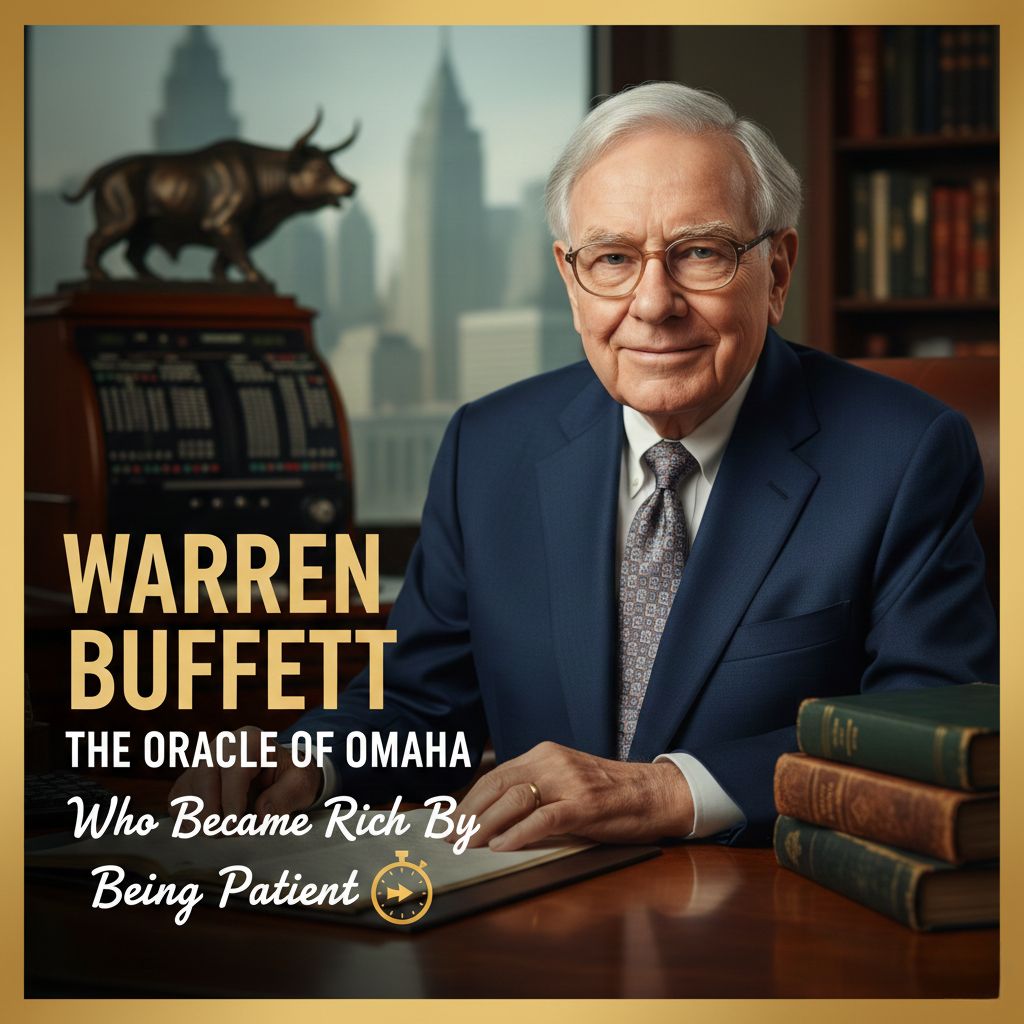
Introduction: The Billionaire Who Still Lives in His Old House
Imagine being one of the richest people in the world but still living in the same house you bought in 1958. Imagine driving an old car and eating breakfast at McDonald's. Sounds strange, right? But that's exactly who Warren Buffett is.
This is not a story about getting rich quick. It's about getting rich slowly. It's about patience, discipline, and making smart choices over and over again for decades.
The Early Days
A Boy Who Loved Numbers
Warren Buffett was born in 1930 in Omaha, Nebraska, during the Great Depression. Money was tight for everyone. But young Warren was different. He was obsessed with numbers and money from a very young age.
At six years old, he bought six-packs of Coca-Cola from his grandfather's store for 25 cents. Then he sold each bottle for a nickel, making a 20% profit. Most kids played with toys. Warren was already thinking about business.
The Paperboy Millionaire
At 13, Warren had a paper route. But he didn't just deliver papers like other kids. He treated it like a business. He had multiple routes and hired other kids to help him. By the time he was in high school, he was making more money than his teachers.
He saved almost every penny he made. While his friends spent money on movies and candy, Warren was thinking about investments.
He filed his first tax return at age 13. Think about that. Most 13-year-olds don't even know what taxes are.
The First Real Investment
At 11 years old, Warren bought his first stock. He purchased three shares of Cities Service Preferred at $38 per share. The price dropped to $27, and he got scared. When it went back up to $40, he sold quickly to make a small profit.
But then the stock kept going up to $200. This taught him a valuable lesson he never forgot: Be patient. Don't panic. Good investments take time.
First lesson: Patience is the most powerful tool in building wealth. Don't rush.
Learning from the Best
Finding His Mentor
After high school, Buffett went to Columbia Business School. There, he met Benjamin Graham, a professor who changed his life forever.
Graham taught something called "value investing." The idea was simple: Find good companies that are selling for less than they're worth. Buy them cheap. Wait. Let time do its magic.
This clicked with Warren immediately. It matched how he already thought about money.
Working for Free
After graduation, Buffett wanted to work for Graham's company so badly that he offered to work for free. Graham said no at first. But eventually, he hired Warren.
Buffett learned everything he could. He studied companies day and night. He read financial reports until his eyes hurt. He was like a sponge, soaking up knowledge.
Second lesson: Find someone who knows what you want to learn. Study them. Learn everything they know.
Starting His Own Partnership
The $105,000 Beginning
In 1956, at age 25, Buffett started his own investment partnership with $105,000 from family and friends. He put in just $100 of his own money. That's all he had.
He made a simple promise to his investors: He would invest their money the same way he invested his own. No tricks. No shortcuts. Just smart, patient investing.
The Boring Strategy That Worked
While other investors chased hot stocks and tried to time the market, Buffett did something boring. He looked for undervalued companies. He bought them. He held them. He waited.
People thought he was too conservative. Too careful. Too boring.
But year after year, his returns beat the market. Not by being flashy. Just by being smart and patient.
Between 1957 and 1969, his partnership averaged 29.5% annual returns. The stock market averaged 7.4%. That's a massive difference over time.
Third lesson: Boring and consistent beats exciting and risky. Every single time.
The Big Move - Buying Berkshire Hathaway
From Textile Company to Investment Giant
In 1962, Buffett started buying shares of a struggling textile company called Berkshire Hathaway. It was cheap. Maybe too cheap. There was a reason - the company was failing.
Most people would have avoided it. But Buffett saw something else. He eventually took control of the company and made a bold decision. Instead of fixing the textile business, he turned Berkshire into an investment company.
Building an Empire Slowly
Through Berkshire Hathaway, Buffett started buying entire companies. Insurance companies. Candy shops. Furniture stores. Newspapers. If it was a good business at a fair price, he bought it.
He didn't buy and flip. He bought and held. Some of his investments have been held for 30, 40, even 50 years.
His strategy was simple: Find great companies. Pay a fair price. Let them grow. Don't interfere too much.
The Philosophy That Made Billions
Rule Number One
Buffett has two famous rules about investing:
Rule #1: Never lose money. Rule #2: Never forget rule #1.
This sounds simple, but it's profound. He doesn't take crazy risks. He doesn't gamble. He only invests in things he understands.
The Circle of Competence
Buffett talks about something called a "circle of competence." This means only investing in businesses you truly understand.
During the dot-com boom in the late 1990s, everyone was buying tech stocks. They were going up like crazy. People thought Buffett was old and out of touch because he didn't buy them.
Why didn't he? Because he didn't understand them. He admitted it freely. "I don't know how to value these companies," he said.
People laughed. Then the bubble burst in 2000. Tech stocks crashed. Investors lost trillions. But Buffett? He was fine. He stuck to what he knew.
Fourth lesson: Only do what you understand. It's okay to say "I don't know." It's not okay to pretend you do.
The Personal Life of a Billionaire
Living Like a Regular Person
Here's what's crazy about Buffett. He's worth over $100 billion, but he lives in the same house in Omaha that he bought in 1958 for $31,500. No mansion. No private island. Just a regular house in a regular neighborhood.
He drives himself to work. No chauffeur. No fancy car. He drives a modest sedan.
The $3 Breakfast
Every morning, Buffett stops at McDonald's for breakfast. He orders one of three things, depending on how the stock market is doing. If stocks are down, he orders the cheapest option - $2.61. If they're up, he splurges on $3.17.
Think about that. One of the richest men in the world decides his breakfast based on a few cents difference.
Why Live So Simply?
People ask him why he doesn't spend more. His answer is simple: "I have everything I need. Why would I need more?"
He doesn't care about impressing people. He doesn't need fancy things. He found what makes him happy - reading, learning, and doing good work. Everything else is just noise.
Fifth lesson: Money is a tool, not the goal. Happiness comes from doing what you love, not from buying stuff.
The Reading Machine
Five Hours Every Day
Buffett's secret weapon isn't complicated math or insider information. It's reading.
He spends about 80% of his day reading. Annual reports. Newspapers. Books. Anything that helps him learn about businesses and the world.
He reads 500 pages a day. Every single day.
When asked about his success, he once held up a stack of papers and said, "Read 500 pages like this every day. That's how knowledge works. It builds up, like compound interest."
Learning Never Stops
At 94 years old, Buffett still reads for five to six hours every day. He's still learning. Still curious. Still asking questions.
Most people stop learning after school. Buffett never stopped. That's a huge part of why he's so successful.
Sixth lesson: Never stop learning. Read. Study. Grow. Knowledge compounds just like money.
The Partnership with Charlie Munger
Finding His Perfect Partner
In 1959, Buffett met Charlie Munger. They became business partners and best friends. Munger joined Berkshire Hathaway in 1978 as Vice Chairman.
Charlie was different from Warren but complementary. Warren focused on finding cheap companies. Charlie taught him to find great companies at fair prices instead.
Together, they built Berkshire into what it is today.
The Power of Partnership
Buffett often says he wouldn't be as successful without Munger. They challenge each other. They make each other think harder. They trust each other completely.
Their meetings are simple. No PowerPoints. No fancy presentations. Just two old friends talking about businesses and making decisions.
Seventh lesson: Find people who make you better. Real success often comes from great partnerships.
The Biggest Mistakes
Admitting When You're Wrong
Buffett is famous for admitting his mistakes. Every year, in his letter to shareholders, he talks openly about what he did wrong.
He held onto the textile business too long. He passed on investing in Google and Amazon early. He missed opportunities because he didn't understand technology.
But here's the thing - he learns from every mistake. He doesn't hide them. He doesn't make excuses. He owns them and moves forward.
The Importance of Humility
Despite being one of the most successful investors ever, Buffett stays humble. He knows he doesn't know everything. He's comfortable saying "I don't know."
This humility has saved him from making bigger mistakes. He doesn't invest in things just because everyone else is. He sticks to his principles.
Eighth lesson: Admit your mistakes. Learn from them. Humility keeps you from making bigger errors.
Giving It All Away
The $100 Billion Pledge
In 2006, Buffett made a shocking announcement. He would give away 99% of his wealth to charity. That's over $100 billion.
The majority goes to the Bill and Melinda Gates Foundation. The rest goes to his kids' foundations and other charities.
Why Give It Away?
People asked why he didn't leave it to his kids. He said something interesting: "I want to give my kids enough so they can do anything, but not so much that they do nothing."
He believes that passing massive wealth to children often hurts them more than helps them.
The Giving Pledge
Along with Bill Gates, Buffett created the Giving Pledge. They challenged other billionaires to give away at least half their wealth.
So far, over 200 billionaires have signed the pledge.
Buffett doesn't want credit. He doesn't put his name on buildings. He just wants to help solve problems and make the world better.
Ninth lesson: True success means helping others. Money means nothing if you keep it all to yourself.
The Simple Rules He Lives By
Buffett's Investment Philosophy
Over the decades, Buffett has shared his investing wisdom freely. Here are his core principles:
Invest in what you understand. Don't chase trends.
Buy quality companies at fair prices. Cheap isn't always good.
Think long-term. Hold for years, not months.
Don't try to time the market. You'll fail.
Be greedy when others are fearful. Be fearful when others are greedy.
Life Principles Beyond Money
But his wisdom goes beyond investing:
Associate with people better than yourself. They'll pull you up.
The best investment you can make is in yourself. Education and skills compound forever.
Reputation takes years to build and seconds to destroy. Protect it.
Do what you love. He says if you take a job for the resume, you're already making a mistake.
What We Can Learn
Lessons for Regular People
You don't need to be rich to learn from Buffett. His lessons work for anyone:
If you're starting out with money, start small. Buffett started with $100. What matters is starting and learning.
If you're tempted by get-rich-quick schemes, remember Buffett's boring approach. Slow and steady wins.
If you're struggling with patience, think about compound interest. Small gains add up over decades to massive wealth.
If you're afraid to invest, start by learning. Read. Study. Understand before you invest a single dollar.
If you chase expensive things, ask yourself what Buffett asks: Do I need this, or do I want to impress someone?
The Wisdom at 94
Still Working, Still Learning
Today, at 94, Buffett still goes to the office. He still reads all day. He still makes investment decisions.
He's not working because he needs the money. He works because he loves it.
In his annual shareholder meetings, thousands of people come to hear him speak. They call him the Oracle of Omaha. They hang on his every word.
But he's still the same guy who eats McDonald's for breakfast and drives himself to work.
Final Thoughts
The Real Secret
Warren Buffett's story isn't about genius investing moves or secret formulas. It's about patience. Discipline. Learning. Humility. And time.
He didn't get rich overnight. He didn't take crazy risks. He didn't try to beat the system.
He just made smart decisions over and over for 70 years. He let compound interest do its magic. He stayed curious. He learned from mistakes. He helped others.
That's it. That's the secret.
Tenth lesson: There are no shortcuts to lasting success. It's built one good decision at a time, over many years.
Conclusion: Start Your Journey
You probably won't become a billionaire. Most of us won't. But that's not the point.
The point is you can live by his principles. Save more than you spend. Invest in what you understand. Be patient. Keep learning. Help others.
Start today. Start small. But start.
Read one book. Save one dollar. Learn one new thing.
Then do it again tomorrow. And the next day. And the day after that.
That's what Warren did. That's what made him the Oracle of Omaha.
And those same simple principles can change your life too.
The best time to start was 20 years ago. The second best time is right now.
What are you waiting for?
Amazon Affiliate Disclosure
As an Amazon Associate I earn from qualifying purchases.
Comments
pramodchaudhary2006
November 26,2025
Nice
khushikhatik016
November 27,2025
This is the very amazing
khushikhatik016
November 27,2025
This is the best
pramodchaudhary2006
November 27,2025
Very nice
pramodchaudhary2006
November 27,2025
This is the good
pramodchaudhary2006
November 27,2025
This is the best
pramodchaudhary2006
November 27,2025
Good
pramodchaudhary2006
November 27,2025
Good
pramodchaudhary2006
November 27,2025
Good
pramodchaudhary2006
November 27,2025
Good
pramodchaudhary2006
November 27,2025
Good
pramodchaudhary2006
November 27,2025
Good
pramodchaudhary2006
November 27,2025
Good
pramodchaudhary2006
November 27,2025
Good
pramodchaudhary2006
November 27,2025
Good
pramodchaudhary2006
November 27,2025
Good
pramodchaudhary2006
November 27,2025
Good
pramodchaudhary2006
November 27,2025
Good
pramodchaudhary2006
November 27,2025
Good
pramodchaudhary2006
November 27,2025
Good
pramodchaudhary2006
November 27,2025
Good
pramodchaudhary2006
November 27,2025
Good
pramodchaudhary2006
November 27,2025
Good
pramodchaudhary2006
November 27,2025
Good
pramodchaudhary2006
November 27,2025
Good
pramodchaudhary2006
November 27,2025
Good
pramodchaudhary2006
November 27,2025
Good
pramodchaudhary2006
November 27,2025
Good
nisar1991ahmed
December 02,2025
Good