
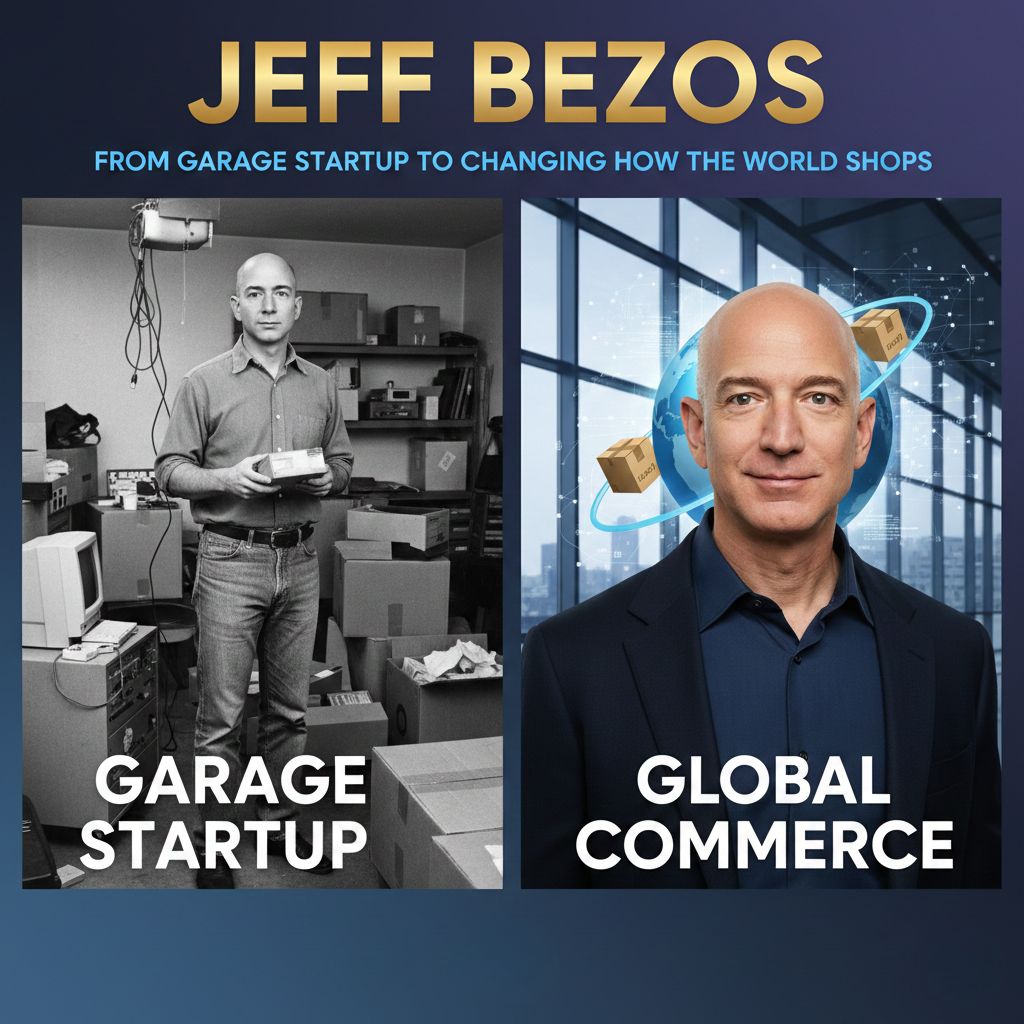
Jeff Bezos - From Garage Startup to Changing How the World Shops
By: Compiled from various sources | Published on Nov 24,2025
Category Moral Stories
Introduction: The Man Who Changed Shopping Forever
When you order something online and it shows up at your door the next day, you don't think twice about it. But there was a time when this seemed impossible. Behind this change stands one man who started with a simple idea in his garage. His name is Jeff Bezos.
This story is not just about becoming rich. It's about having a vision when everyone thought you were crazy. It's about taking risks that scared your closest friends. And it's about staying focused on what matters.
The Early Days
A Curious Kid with Big Dreams
Jeff Bezos was born in 1964 in New Mexico. His mother was just a teenager when he was born. Life was not easy at first. But young Jeff showed signs of being different.
As a child, he loved taking things apart to see how they worked. He would even dismantle his crib with a screwdriver. His grandfather had a ranch in Texas where Jeff spent his summers learning about hard work and fixing things.
He was not born rich. He did not have special connections. He was just a curious kid who asked lots of questions.
From Princeton to Wall Street
Bezos did well in school. He loved science and computers. After graduating from Princeton University with degrees in engineering and computer science, he worked on Wall Street. He had a comfortable life. But something was missing.
The Decision That Changed Everything
Spotting the Internet Gold Rush
In 1994, Bezos learned that internet usage was growing at 2300% per year. That number was insane. Something clicked in his mind. This was a huge opportunity.
He made a list of products he could sell online. After thinking it through, he chose books. Why? Because there were millions of titles - way more than any physical store could hold. Plus, books were easy to ship.
The Regret Minimization Framework
When he told his boss about leaving to start an online bookstore, his boss warned him. He had a great career ahead. Why risk it all?
Bezos went for a walk to think. He created what he called a "regret minimization framework." He imagined himself at 80 years old. Would he regret leaving a safe job to chase his dream? Or would he regret never trying?
The answer was clear. If he didn't try, he would always wonder "what if?"
First lesson: When you have a dream, don't let fear stop you. The biggest regret is never trying at all.
Starting in the Garage
Building Desks from Old Doors
Bezos and his wife MacKenzie drove across the country to Seattle. On the way, he typed up the business plan on his laptop. They were planning the future while driving.
They started Amazon in their garage. Bezos built desks out of old doors because it was cheaper. He packed boxes himself. He drove packages to the post office.
The Bell That Wouldn't Stop Ringing
In the beginning, a bell rang every time someone made a purchase. Everyone would gather around to see what sold. Within weeks, the bell rang so much they had to turn it off.
But it wasn't easy. People laughed at the idea. "Why would anyone buy books online when they can go to a bookstore?"
A Father's Faith
His parents invested $300,000. When asked if he was worried about losing the money, his dad said something beautiful: "I wasn't betting on the idea. I was betting on my son."
That kind of faith pushes people to work harder than they ever thought possible.
Surviving the Crash
From Bookstore to Everything Store
In the late 1990s, the internet was booming. Amazon grew fast. Then Bezos shocked everyone - he decided to sell more than just books.
People thought he was crazy. "You're a bookstore. Stick to what you know."
But Bezos had a bigger vision. He wanted to build "the everything store" where people could buy anything.
When the Bubble Burst
Then came the year 2000. The dot-com bubble burst. Internet companies failed everywhere. Amazon's stock dropped from $100 to just $6. The company was losing money.
Critics said Amazon would fail soon. Some called it "Amazon.bomb." Employees worried. Investors panicked.
What did Bezos do? He stayed calm. He kept focusing on customers. He kept improving the website. He kept thinking long-term.
He told his team, "We are willing to be misunderstood for long periods of time."
Second lesson: When you believe in something, don't change course just because others doubt you. Stay focused.
Customer First, Always
The Power of Long-Term Thinking
While other companies chased quick profits, Bezos built for the long haul. His philosophy was simple: "We're not competitor obsessed, we're customer obsessed."
Instead of worrying about other companies, Amazon asked: "What do customers want?"
Making Customers Happy
Customers wanted lower prices. Amazon kept prices low, even with smaller profits.
Customers wanted faster shipping. Amazon built warehouses everywhere and created Prime.
Customers wanted more choices. Amazon let other sellers use their platform.
Every decision came back to one question: "Is this good for the customer?"
Playing the Long Game
This was different. Most companies wanted money now. Bezos was willing to wait. He invested profits back into making the business better.
Wall Street complained that Amazon didn't make enough profit. Bezos didn't care. He was building for ten years ahead, not for the next quarter.
This patience paid off. While other online stores died, Amazon kept growing. Today, it's one of the most valuable companies in the world.
Third lesson: Think long-term. Quick success fades. If you build something solid, it lasts.
The Space Dream
Blue Origin - Reaching for the Stars
Once Amazon became successful, Bezos could have relaxed. But he had another dream - space.
In 2000, he started Blue Origin, a space company. His goal was making space travel accessible to regular people.
For years, he worked on this quietly. He sold billions of Amazon stock to fund it.
Flying to Space
Why space? Bezos believes Earth's resources are limited. One day, humans might need to live in space. He wants to help make that possible.
In 2021, he flew to space himself in a Blue Origin rocket. At 57, he fulfilled his childhood dream.
Fourth lesson: Success isn't about the money you make. It's what you do with it. Use success to chase bigger dreams.
The Other Side
Facing the Criticism
No story is complete without the other side. Bezos and Amazon face criticism too.
Workers in warehouses complain about tough conditions. Small businesses say Amazon has too much power. During the pandemic, Bezos became the richest person while millions struggled. People questioned if anyone should have that much wealth.
Trying to Do Better
These are real concerns. Success comes with responsibility.
Bezos has tried to respond. He raised minimum wage to $15 per hour. He pledged $10 billion to fight climate change. After stepping down as CEO, he focused more on giving back.
The lesson: No matter how successful you become, stay humble. Listen to criticism. Always look for ways to do better.
Simple Principles That Worked
The Rules He Followed
Looking at his journey, clear patterns emerge:
Start before you're ready. Bezos launched Amazon without knowing if it would work. He learned as he went.
Focus on what matters. For him, that was the customer.
Think long-term. Don't chase quick wins.
Be willing to fail. Amazon had many flops. The Fire Phone was a disaster. But they learned and moved on.
Stay curious. Bezos still asks questions, still learns.
Be stubborn on vision but flexible on details. He never changed his customer focus. But he changed methods constantly.
What We Can Learn
Lessons for Your Life
You don't have to start Amazon to learn from this story.
If you're starting something, focus on solving real problems. Don't just chase money.
If you're scared to try something new, remember the regret framework. What will you regret more - trying and failing, or never trying?
If people doubt you, stay focused. If everyone agrees immediately, you're probably not doing anything interesting.
If you succeed at something, don't stop there. Use that success for the next challenge.
The Human Side
Beyond the Billionaire
Who is Bezos as a person? He has interesting habits.
He doesn't schedule meetings before 10 am. He likes slow mornings with family. He believes in eight hours of sleep for clear thinking.
In meetings, everyone sits in silence for 30 minutes reading a memo first. This ensures people actually understand what they're discussing.
He does the dishes after dinner. Despite being one of the richest people ever, he still does this simple chore.
These details matter. They show he's human. Yes, he built an empire. But he still values simple things.
Looking Forward
What's Next for Bezos
What's next? He's focusing on space exploration with Blue Origin. He's working on the Earth Fund to combat climate change. He owns The Washington Post.
At 60, he shows no signs of slowing down. The boy who took apart his crib is still building new things.
Final Thoughts
The Real Moral of the Story
From a garage to changing how billions shop, from books to space, Bezos's journey is remarkable. It's vision meeting hard work. Risks meeting rewards. Failures meeting learning.
But beyond the billions, it's a human story. It's about a kid who loved taking things apart. Someone who asked "what if?" and did something about it.
You might never build Amazon. You might never fly to space. But you can apply these lessons to your life.
Think long-term. Focus on serving others. Take smart risks. Stay curious. Work hard. When you succeed, do even bigger things.
That's the real moral here. Success isn't the destination. It's the journey, the impact you make, and the dreams you chase.
Conclusion: Your Turn to Start
So what's your regret framework? What will you wish you had tried?
Don't wait for the perfect moment. Start now. Start small. But start.
Who knows? Maybe your story will inspire someone else someday.
Amazon Affiliate Disclosure
As an Amazon Associate I earn from qualifying purchases.
Comments
pramodchaudhary2006
November 27,2025
Very nice
pramodchaudhary2006
November 27,2025
Good